Archive for the ‘Gribbins News’ Category
Gribbins Wins the Crystal Eagle!

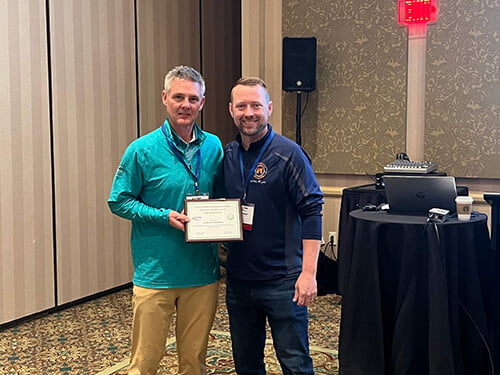
Trevor Atherton, Safety Manager (center), and JD Smothers, Terre Haute Area Manager (right), accepted the prestigious Indiana construction award on May 2.
Gribbins Insulation was honored by the Metro Indianapolis Coalition for Construction Safety Inc. (MICCS) with the 2013 Excellence in Safety Award, better known in industry circles as the coveted “Crystal Eagle.” Gribbins Safety Manager Trevor Atherton accepted the award at the 20th annual MICCS Awards Banquet on May 2, 2013, at the Indiana Convention Center Sagamore Ballroom in downtown Indianapolis.
Indiana construction companies of all sizes submit applications for the prestigious MICCS awards program, which then compete in categories with their peers. Each category winner is recognized as a Safety Leader and is then in contention for the “Crystal Eagle.” Gribbins Insulation, a MICCS-IDOL Certified Partner and the Safety Leader winner in the “Trade Partner Over 300,000 Hours” category, was chosen from the five Safety Leader winners for MICCS’s highest honor. As one judge stated, Gribbins Insulation won the Crystal Eagle because “they are taking behavioral safety to another level.”
Gribbins Insulation president and founder Jim Gribbins stated, “As an Indiana contractor for almost 30 years, we appreciate MICCS recognition of our program as a state leader. Our employees place safety in front of all actions, and this award honors each individual’s commitment.”
Gribbins Insulation consistently receives national recognition for its safety program. Other 2013 safety awards include the Indiana Governor’s Workplace Safety Award for Safety Innovation and the Platinum Safety Award from the National Insulation Association, the highest honor from the national trade association for mechanical insulation. In 2011, Gribbins Insulation was honored as one of America’s Safest Companies by EHS Today, and in 2012, the National Safety Council selected Jim Gribbins, president and founder, as one of eight CEO’s Who Get It.
The Metro Indianapolis Coalition for Construction Safety, Inc. (MICCS) is dedicated to the elimination of construction and facilities maintenance jobsite injuries and illnesses with the ultimate objective of returning construction and maintenance workers home to their families, friends, and communities free from harm. Learn more at www.miccs.org.
Click here to review a full list of Gribbins Insulation’s safety awards.
Contact Megan Knoll, Director of Marketing, with any questions.
Approved Contractor in ISNetworld, PICS Auditing, and Browz
Gribbins Insulation cherishes the opportunity to share information about our award-winning safety program. With an industry-leading TRIR of only .36 in 2012, our program is proven to help our employees work safer. (The TRIR average for our industry is 3.8.) When clients require contractors to complete a prequalification process, we understand that they value safety as much as we do. We are proud of our membership in several third-party prequalification systems. We continue to update our information in these systems to maintain our status as an approved contractor for all of the clients listed below.
Please note – This is only a list of our approved status in third-party systems. We are approved for most of our clients through their own internal systems.
If you have any questions about this list or our information in these systems, please contact our Director of Marketing (and prequalification manager) Megan Knoll at mknoll@gribbins.com.

ISNetworld
Featured contractor on ISNetworld
AK Steel
Chevron
International Paper
JBS USA – Pilgrims
Kellogg Company
POET
Rain CII Carbon
Safety Management, Inc
Cargill
Gribbins Wins Toyota Safety Award
Toyota Motor Engineering & Manufacturing North America, Inc., honored Gribbins Insulation with the Supplier Safety Award at the Annual Purchasing Policy Business Meeting for Indirect Suppliers on June 28, 2012, in Covington, Kentucky.
Gribbins Insulation was chosen for the prestigious Toyota Supplier Safety Award from among key indirect suppliers to its North American facilities. Toyota selected Gribbins for this recognition because of their proven ability over the course of the previous year to meet, and in many cases exceed, the challenging safety expectations they face as a supplier to Toyota North America.
In addition to winning the overall Safety Award, Gribbins Insulation received nominations for the Quality Award as well as the Superior Performance Award, which reflects outstanding

Jim Gribbins is pictured with Kevin Butt, Toyota Chief Environmental Officer of Environmental and Safety Engineering
performance across all evaluation categories. The award and nominations reinforce Gribbins Insulation’s commitment to its core values of integrity, safety, quality, productivity, and innovation.
In nominating Gribbins for these awards, Toyota provided the following comment received from one of its team members, “When Gribbins is on the job, we know that we are going to get a top quality job and that all safety guidelines will be followed without us having to follow behind them or make frequent checks of their job site.”
Gribbins Insulation’s safety program consistently receives national recognition. At the end of May 2012, Gribbins employees achieved the remarkable milestone of working two million consecutive hours without a lost time accident – this encompasses almost five years of accident-free work. In April 2012, the National Insulation Association honored Gribbins with the Platinum Safety Award, its highest recognition, and in October 2011, Gribbins was included in the list of America’s Safest Companies in EHS Today. As emphasized by president and founder Jim Gribbins, “There is absolutely no task that is so important that we might consider sacrificing safety, to even the slightest degree, in an effort to perform the task.”
Review a chronological list of all of Gribbins Insulation’s safety accolades.
Summer Safety Tip: Driving Safety
from the National Safety Council
Driving Defensively
Whether your employees drive a motorcycle, a slow moving farm tractor, an 18-wheel tractor trailer, or a high-performance sedan, they all can learn something from the drivers around them. Those who do drive a number of vehicle types may be the safest drivers on the road. Think about it. Though you may have driven alongside all or any of these vehicles, you can’t fully appreciate what it’s like to drive one unless you’ve been behind the wheel. Every driver’s view of the road, as well as the ability to stop suddenly or avoid a pothole, is different. A little information and patience can go a long way when you share the road with different sized vehicles. Drivers need to keep in mind the limitations and capabilities of all the vehicles around them. Motorcycles are small, fast and easy to maneuver on clean pavement. A motorcyclist can sometimes avoid potential collisions because motorcycles are easier to maneuver than other vehicles. However, motorcyclists also share the greatest risk of personal injury if they are involved in a collision. Slippery, wet or gravel conditions can be hazardous, so drivers of other vehicles should give motorcyclists their legal space on the road. While slow-moving vehicles such as combines or tractors cannot react quickly, the vehicle’s slow pace gives the driver the chance to plan how to react but they have little lane space to use.
Seeing is believing
Car and motorcycle drivers have better side vision than a truck driver. Truck and bus drivers can see more than cars and motorcycles when they look forward because they sit higher up. But the larger and longer the truck, the less the driver can see from behind. Car drivers often have no idea how large the blind spots are on trucks and buses. Just as a trucker can blind a fellow motorist with his high beams in oncoming traffic or from behind, the driver of a car can blind a truck driver. Be aware of the effect bright lights may have on other drivers. Cars have shorter stopping distances and, like motorcycles, greater maneuverability than trucks. With trucks, the heavier the truck, the more stopping distance it requires. If truck drivers try to stop suddenly the weight of a heavy load can force the truck forward. This makes it impossible for even the best of truck drivers to stop short. An unplanned emergency stop may also cause a jackknife. In this case, the cargo in the trailer causes it to skid alongside the tractor taking out the entire next lane and every vehicle in it. And because some truck have a higher center of gravity, it’s easier to roll a truck than a car if the truck takes a turn too quickly. To eliminate these situations, all drivers should avoid tailgating.
Defensive driving puts you in control
Since riding a motorcycle is far more dangerous than driving a car or truck, the National Safety Council suggests drivers put extra following distance between their vehicles and motorcycles. This means using a four or five second following distance. It is important to be careful around individuals who ride a motorcycle without a helmet or other protective equipment. To drive defensively, use a space cushion, make your vehicle visible to other drivers, and allow yourself time to make decisions.
When you drive near a slow-moving vehicle, the National Safety Council defensive driving courses suggest three tactics:
- Stay back far enough to see around it
- Don’t become impatient
- When it’s safe to pass, give the vehicle plenty of room
Many trucks crash when backing. To avoid this, drivers should get out and check all sides to ensure there is ample clearance. On the road, drivers of smaller vehicles should recognize that a truck turning one way will sometimes first swing the other way in order to make the turn. Truck drivers must also be aware of hurried drivers.
To drive defensively around large vehicles:
- Don’t drive in their blind spots
- Don’t tailgate or cut in too soon after you pass
- Don’t crowd the vehicle
- Be prepared for wind gusts when you pass
Professional drivers of heavy trucks and tractor trailers know that their vehicles push a block of air ahead of them and around the sides, which causes a slight vacuum of air behind. Truckers call this turbulence. Inexperienced drivers, especially drivers of rental vehicles, may not know how to deal with the turbulence and could veer off the road or into on-coming traffic.
Navigating around nonprofessionals
Nonprofessional drivers require special consideration by other drivers. This is especially true of drivers of rented vehicles, such as people who rent trucks when moving. Renters may not be familiar with the size and feel of the rented vehicle, and can become fatigued from driving long periods of time. For instance, drivers of rented trucks may tend to operate the truck the same way the driver does a car. However, different rules can apply to trucks, as opposed to cars, when it comes to applying the brakes, necessary turning radius and overhead clearance. It is also a good rule of thumb that trucks should drive under the posted speed limit due to the increased braking distance needed if the truck is loaded. If you drive defensively, know and respect your vehicle and give courtesy to other drivers on the road, you’ll be able to share the road with vehicles of any size and drivers of all abilities.
The photo above was taken from the Safety Training Videos By Digital-2000‘s website.
Summer Safety Tip: Preventing Slips, Trips, and Falls
From the National Safety Council
Hazards Hiding in the Dark: What to do When the Power Goes Out
When the power goes out unexpectedly in a home, the resulting darkness can bring about a number of hazards. Families can eliminate the odds of injury by knowing what to watch for and actions to take before power is lost. 
Electrical and fire hazards
One of the first actions a person should take when the power goes out is immediately shut off all unnecessary electrical appliances and equipment. Keep one light plugged in and turned to “On” to signal when power is restored. The National Fire Protection Association in Quincy, MA, recommends homeowners use flashlights instead of candles or glow sticks during power outages because candles, when left unattended, can easily ignite objects and lead to a home fire. (On average, a candle fire in the home is reported every 34 minutes.) According to the NFPA, nearly 3,000 people a year die in fires, and more than 80 percent of fatalities are a result of home fires.
The NFPA advises people to:
- Keep batteries on hand to replenish flashlights.
- Make sure the battery in your smoke detector is fresh, and test the detector to ensure it is working.
- Never leave a child alone in a room with a burning candle.
- Keep matches and lighters out of reach of children.
- If you do burn candles, make sure they are at least 12 inches away from any-thing flammable.
- Use candle holders that are sturdy and will not tip over.
- Never use a candle in a home where medical oxygen is used.
- Do not burn a candle all the way down to the holder or container.
- Always blow out all candles when you leave the room or go to bed.
- Avoid use of candles in the bedroom and other areas where people may fall asleep.
Extreme temperatures and carbon monoxide
Power outages caused by a thunderstorm or other weather-related event may last only a few hours. However, they sometimes can last longer. According to Dr. Alison Tothy, medical director of the Pediatric Emergency Medicine Department and assistant professor in the Department of Pediatrics at the University of Chicago, power outage injuries treated in emergency rooms often are the result of loss of electricity or gas due to an inability to pay utility bills. Still, accidental injuries during even a short-term power outage are a concern, she said. “Our biggest concern is extreme heat,” Tothy said. During the summer months, people often open windows and position furniture nearby to cool down. Unfortunately, what happens is children manage to climb on either a bed or chair and fall out the window, she said. “A lot of families think that screens are adequate protectors against falling out of windows but they’re not,” Tothy said. “People need to limit the opening of a window to no more than 4 inches.” Window clips or guards can be used to limit openings and still be easily removed in case of a fire.
Another hazard is the threat of carbon monoxide poisoning – often from using portable generators. Approximately 450 Americans died from unintentional CO poisoning from 1999 to 2004, according to the Centers for Disease Control and Prevention. More than 20,000 people visit emergency rooms and more than 4,000 are hospitalized due to CO annually. Approximately 73 percent of these exposures occur in the home, and 41 percent occur during winter months (December to February). According to the Washington-based non-profit Safe Kids Worldwide, young children are more susceptible to CO and may experience symptoms sooner than a healthy adult. Due to their smaller bodies, children process CO differently than adults and may be more severely affected by CO in their blood. CO poisoning occurs when the exhaust from a generator is inhaled, and can lead to incapacitation or death in a matter of minutes. Common symptoms of CO poisoning include headache, flushed or red complexions, dizziness, weakness, nausea, vomiting, chest pain, and confusion.
The Consumer Product Safety Commission advises families to exercise extreme caution when using generators during a power outage and offers the following safety tips:
- Shut off all unnecessary electrical appliances and equipment.
- Plug individual appliances into the generator using heavy-duty, outdoor-rated cords with a wire gauge adequate for the appliance load.
- Install battery-operated CO alarms or plug-in CO alarms with battery back-up. Test them frequently and replace dead batteries.
- Only run a portable generator out-doors with adequate ventilation. Never use a generator indoors or in attached garages. Opening doors and windows or using fans will not pre-vent CO buildup.
During the winter months, some families may use generators or open their ovens to heat their house, but doing so puts them at risk of CO poisoning as well as stove burns. If families find they cannot keep warm, they should leave the home and go to a rescue center, Tothy said.
Know what is safe to eat
While the urge to clean out the refrigerator and freezer to get rid of potentially rotten food might be strong during a power outage, the CDC advises using discretion before disposing all contents. While the power is out, keep the refrigerator and freezer doors closed as much as possible, the CDC said. Thawed food that contains ice crystals or is 40°F or colder can be refrozen or cooked; however, items that should be thrown away include:
- Food that has an unusual odor, color or texture
- Food that may have come in contact with flood or storm water
- Perishable foods that have been exposed to a temperature of 40°F or warmer for two or more hours
- Canned foods that are bulging, open or damaged
Food spoilage is of particular concern for infants and young children who use milk formula-based products, Tothy said. She recommended parents limit the amount of formula they mix so as to only use the amount needed at the time, and keep the powder and water separate.
Use safe water
Safe water for drinking, cooking and personal hygiene may not be available if water purification systems are not functioning when the power goes out. The CDC offers the following general rules concerning safe water:
- Do not use contaminated water to wash dishes, brush your teeth, wash and prepare food, wash your hands, make ice, or prepare baby formula.
- Use alcohol-based hand sanitizer to wash your hands.
- Boil water for at least one minute to kill harmful bacteria and parasites.
Tothy warns that emergency water supplies also can present a drowning hazard. Some families who want to con-serve clean water will fill bathtubs, sinks or buckets with water and leave them. But doing so exposes children, especially toddlers, to the risk of drowning, she said.
Injury preparation
The National Safety Council advises families to maintain a first aid or emergency supply kit. First aid kits should include a triangle bandage, adhesive tape, adhesive bandages, burn treatment ointment, medical exam gloves, antiseptic towelettes and sterile dressing. Additional items can include antibiotic treatment, bandage compresses, absorbent compresses, roller bandages, eye coverings, eyewash, a cold pack, an emergency blanket, scissors, tweezers, disposable bags, waterless hand sanitizer and a barrier device.
The photo above was taken from Southern California Edison‘s website.
Summer Safety Tip: Ergonomics
From the National Safety Council
Ergonomics
Ergonomics involves designing and arranging workspaces so people work efficiently and safely. Ergonomics is used to evaluate how you do your work to identify any risk factors that might lead to injury, and then to find the best solution to eliminate or manage the hazard. Your capabilities and limitations are taken into account to ensure tasks, equipment, information and your environment suit you.
What are ergonomic conditions?
Ergonomic conditions are disorders of the soft tissues, specifically of the muscles, nerves, tendons, ligaments, joints, cartilage, blood vessels, and spinal discs. If you experience pain or injury in your soft tissues, it might be caused by factors such as repetition, force, awkward postures, contact stress, or vibration and may develop over time. These types of injuries and pains are not caused by slips, trips, falls or motor vehicle collisions.
Ergonomics injuries
Perhaps the most prevalent injuries in an office setting are related to ergonomics. Because office workers spend the bulk of their day seated at a desk and working on a computer, they are prone to strains and other injuries related to posture and repetitive movement. Ergonomics hazards can be difficult to detect. “Most office conditions that can be described as hazardous from an ergonomics perspective would appear quite innocuous to the everyday observer,” said Marc Turina, principal consultant for ErgoSmart Consultants in McKees Rocks, PA.
The following are steps that should be taken in order to be ergonomically safe in the office.
Provide Adjustable Equipment
One size does not fit all in an office workstation. “Adjustability is the key,” Turina said. “Chairs, work surfaces, monitor stands, etc., should all be adjustable in order to accommodate the widest range of employees.” He recommended presenting a variety of options to employees. Although employers may be reluctant to pay for expensive ergonomic equipment, experts insist the equipment is a wise investment. “A good keyboard tray may retail around $300; a good chair may retail around $500 to $700,” said Sonia Paquette, professional ergonomist and doctor of occupational therapy. She points out that the cost of the health claims that stem from not having these devices is much higher. “Some of these hard claims cost many tens of thousands of dollars just of medical treatment, let alone cost of replacement, absenteeism, loss of work production, etc.”
Train Workers on How to Use Equipment
Providing adjustable furniture and equipment is only the first step in creating an ergonomically sound workstation. “A big issue that I have encountered a lot lately is employee inability to properly adjust their own office chairs,” Turina said. “Many times, employers can invest $500 in an excellent adjustable chair, but employees still experience a bad workstation fit.” The problem often is twofold: Workers do not know how to adjust their equipment, and they do not know the most ergonomically beneficial way to set up their workstation. Train workers on both the ideal setup and how to operate adjustable equipment accordingly.
Keep Your Feet on the Floor
One of the first questions Paquette asks workers is whether their feet touch the floor when seated at their desk. “It sounds like an incredibly simple question,” she said, “but very often workers have their keyboard tray on the desktop, so in order to reach it, they need to jack up their chair so high that their feet can barely touch the floor.” She added that unless an employee’s feet are on the floor, a chair will not be able to reduce pain and discomfort. She recommended options such as adjustable keyboard trays or rolling tables adjusted to the proper height to eliminate this problem. Although footrests are a “second-best option,” their small surface may impede some of the worker’s movement.
Provide Document Holders
Frequently typing from hard copy can lead to neck strain if a worker is forced to repeatedly look down to the desk and back to the computer screen. Turina recommends providing document holders to reduce this strain. “These document holders are reasonably priced, and eliminate excessive cervical motion and help to prevent muscle imbalances,” he said. Document holders also are good for the eyes, according to the St. Louis-based American Optometric Association. Keeping reference materials close to the monitor reduces the need for your eyes to change focus as you look from the document to the monitor.
Correct Mouse Placement
Paquette often sees workstations where the computer keyboard is on a tray, but the mouse remains on the desk. “That spells disaster for the neck and shoulder on the side of that mouse,” she said. She recommends that the mouse always be placed beside the keyboard.
The picture above was taken from ergonomics-info.com.
Summer Safety Tip: Employee Wellness

From the National Safety Council
Consumption of caloric sweeteners such as sugar increased 39 percent between 1950 and 2000, according to the U.S. Department of Agriculture. Because excessive sugar consumption can raise insulin levels, cause tooth decay and make it difficult to maintain a healthy weight, many health experts are concerned by the ever-increasing amounts of sugar in the average American diet.
Recommended Amounts of Sugar
Unlike many vitamins and nutrients, a recommended daily value for sugar does not exist. The 2010 Dietary Guidelines for Americans simply suggests individuals limit their daily intake to no more than 10 percent of total calories from added sugars. “So if you are eating 2,000 calories a day, not more than 200 calories – or 50 grams – should be added sugars,” said Christine Gerbstadt, M.D., spokesperson for the American Dietetic Association. Consuming too much sugar also may lead to weight gain, according to Gerbstadt, who said sugar is easily stored in the body as fat. Additionally, it robs the body of nutrients such as niacin and riboflavin, which help regulate metabolism. There are different forms of sugar, including table sugar, fructose (which occurs naturally in fruit) and lactose (which occurs naturally in dairy products). “From a chemical perspective, these sweeteners all have one common characteristic: they provide 4 calories per gram with little else in terms of valuable nutrients like vitamins and minerals,” Gerbstadt said. “This is why sugar is often referred to as ‘empty calories.’” However, she points out that consuming sugar from natural sources such as fruit, vegetables, grains and dairy products is not inherently unhealthy because these foods come with added nutritional benefits. Rather, it is the added sugars in processed foods that are the main cause for concern.
Limit Your Intake
Sugars can be hidden in a surprising number of products, and may appear on ingredient lists under a number of different names. “They creep up in barbecue and pasta sauce, and canned fruits are loaded with it,” Gerbstadt said. “Scrutinize food labels for refined sugars that go by other names.” The USDA points out that sugar often is listed on food labels under the following names:
- Brown sugar
- Corn sweetener
- Corn syrup
- Dextrose
- Fructose
- Fruit juice concentrates
- Glucose
- High-fructose corn syrup
- Honey
- Invert sugar
- Lactose
- Maltose
- Malt syrup
- Molasses
- Sucrose
- Syrup
Artificial Sweeteners
Currently, the Food and Drug Administration approves five different varieties of artificial sweeteners:
- Acesulfame potassium (commercially available as Sunett or Sweet One)
- Aspartame (Equal, NutraSweet)
- Neotame
- Saccharin (Sugar Twin, Sweet’N Low)
- Sucralose (Splenda)
Additionally, the FDA approves a number of sugar alcohols, which are manufactured versions of the carbohydrates found in fruit. Although these are found in some processed food items, they generally are not used for food preparation in the home. According to the Mayo Clinic in Rochester, MN, these artificial sweeteners provide some possible health benefits, mainly weight control. One teaspoon of sugar contains about 16 calories. If you consider that a 12-ounce can of pop contains 8 teaspoons of added sugar, that means 130 calories could be omitted from your diet if you drank pop that was instead sweetened with a zero-calorie artificial sweetener. Also, the Mayo Clinic points out that artificial sweeteners do not elevate blood sugar in the way table sugar does, making it a good alternative for individuals with diabetes. Yet, in spite of these potential health benefits, artificial sweeteners have been under scrutiny by the scientific community since their inception. Critics have suggested these sweeteners may cause a variety of health ailments, from cancer to attention deficit hyperactivity disorder. The National Cancer Institute and other health agencies contend there is no sound evidence that approved sweeteners increase the risk of cancer or any other health problem. Gerbstadt pointed out that only sweeteners that have passed rigorous tests have been approved for sale, so consumers should not be concerned about the safety of artificial sweeteners. As far as health is concerned, she said “the best rule of thumb is to consume all foods in moderation. A reasonable amount is two servings or less per day.”
‘Natural’ Alternatives
Due in part to people’s concerns about sugar and artificial sweeteners, a number of products have begun marketing themselves as the “natural” option in sweetening food. Agave nectar, maple syrup and honey are among the sweeteners billed as being healthier because they are natural, yet Gerbstadt pointed out that “natural” is a term with no actual legal definition. Sweeteners such as these are not calorie-free and they can lead to tooth decay, so, as with standard table sugar, moderation is key. Gerbstadt further cautioned that diabetics should consider honey and agave nectar the same as sugar because these products will have the same impact on blood sugar.
High-Fructose Corn Syrup
Because it is inexpensive to produce, high-fructose corn syrup is used in a wide variety of processed foods, from pop to bread and salad dressing. Lately, the health and safety of the substance has been called into question. A study in 2010 from Princeton University suggested HFCS may lead to weight gain. In the study, rats that were given access to HFCS gained more weight than those with access only to table sugar – even when the overall calorie intake of both remained equal. “When rats are drinking the high-fructose corn syrup at levels well below those in soda pop, they’re becoming obese – every single one, across the board,” said research associate Bart Hoebel. “Even when rats are fed a high-fat diet, you don’t see this; they don’t all gain extra weight.” However, the American Corn Growers Association disputes claims that HFCS is at the root of the nation’s obesity epidemic, pointing to the fact that obesity rates have continued to climb in spite of HFCS consumption declining in recent years. Although they are not identical, Gerbstadt said “calorie per calorie, there is little physiologic or nutritional difference” between types of HFCS and table sugar. “The concern may be in the fact that HFCS is added to an enormous variety of commercially processed foods, which adds up in calories.” In consuming HFCS – as with sugar, artificial sweeteners and sugar alternatives – moderation is vital to protecting your health, Gerbstadt said. “In moderation, none of these are inherently bad for you, but regular use may keep you shackled to a sugar habit.”
National Safety Month 2012
Each June, the National Safety Council sponsors National Safety Month to help companies raise safety awareness. As a member of the National Safety Council and a company devoted to safety, we want to educate our employees on all the resources available from the National Safety Council during the month of June.
Each week carries a theme that brings attention to critical safety issues. The themes for 2012 are listed below. Click on each link to learn more about that subject:
Week 1: June 3 to 9 Employee Wellness
Week 2: June 10 to 6 Ergonomics
Week 3: June 17 to 23 Preventing Slips, Trips, and Falls
Week 4: June 24 to 30 Driving Safety
Summer Safety
The goal of National Safety Month is to raise a public awareness of safety. June also is an appropriate month to focus efforts on summer safety, as this season is traditionally a time of increased unintentional injuries, both on and off the job. Each Wednesday during June, we will post Summer Safety Tip Sheets from the National Safety Council on the Gribbins Facebook page.
To kick off National Safety Month, here is the first tip sheet: Making Smart Choices
Gribbins Insulation’s core values are: integrity, safety, quality, productivity, and innovation. We hope that you will participate in National Safety Month by reviewing the resources on the NSC website, reading the weekly summer safety tip sheets, and encouraging your friends and family to do the same. We value our employees, and we want them to “think safety” on and off the job.
Gribbins Insulation Wins Five Safety Awards in a Month
From October 26, 2011, to November 17, 2011, Gribbins Insulation received five safety awards from four different organizations.
Gribbins Insulation’s many safety awards reflect the company’s commitment to an effective safety program. As stated by Jim Gribbins, President and Founder, “There is absolutely no task that is so important that we might consider sacrificing safety, to even the slightest degree, in an effort to perform the task.” Most recently, the Indiana Construction Association (ICA) honored Gribbins with two awards – the Gold Summit Award and the Pinnacle Safety Award.
The ICA annually recognizes Indiana contractors and subcontractors for their safety achievements. At the annual membership meeting in Indianapolis on November 17, 2011, Gribbins Insulation received the Gold Summit Safety Award along with eight other contractors. This is the fourth consecutive year the ICA has honored Gribbins with the Gold Summit Award. From the nine recipients, Gribbins was also chosen by the ICA Selection Committee for their highest safety award, the Pinnacle Safety Award, as the overall leader in construction employee safety. Gribbins received this award previously in 2009.
The ICA Safety Awards Program recognizes general contractors, prime contractors, construction managers and subcontractors for their commitment to excellence in employee and jobsite safety. Employees and supervisors of contractors and subcontractors throughout Indiana vying for this award were confidentially surveyed to test how well the company’s safety program is understood and implemented. This allows the Committee to select companies whose safety programs are both well written and effectively implemented on the jobsite. Read more: http://news.inconstruction.org/November2011/111130/ICA_Safety_Awards_Newsletter_Article.pdf
Earlier in the fall, Gribbins Insulation received safety honors from three other national organizations committed to the pursuit of safety excellence.
October 26: At the National Building Museum in Washington, D.C., the National Maintenance Agreements Policy Committee (NMAPC) gave the Zero Injury Safety Awards to companies with zero recordable injuries at jobsites in 2010. Gribbins was recognized for work at three different jobsites, totaling over 194,000 hours worked without injuries. Read more: http://www.nmapc.org/zisa/
October 31: EHS Today named Gribbins one of the 2011 America’s Safest Companies at the award ceremony in Philadelphia, Pennsylvania, along with only twelve other companies, including Fluor Enterprises and Caterpillar Inc. Gribbins was the second smallest company honored. Read more: http://ehstoday.com/safety/management/americas_safest_companies_0111/
November 8: The Construction Users Roundtable (CURT), an association of large construction users including Procter & Gamble and Duke Energy, chose Gribbins Insulation as a winner of the Construction Industry Safety Excellence (CISE) Award during the national conference in Phoenix, Arizona. Applications were accepted from CURT members throughout the United States and Canada. Read more: http://www.curt.org/Awards-Safety-CISE-Awards.aspx
In alphabetical order, Gribbins Insulation won the following safety awards in 2011:
- Construction User’s Roundtable (CURT) Construction Industry Safety Excellence (CISE) Award
- EHS Today’s list of America’s Safest Companies
- Indiana Construction Association (ICA) Gold Summit Award
- Indiana Construction Association (ICA) Pinnacle Award
- Indiana Governor’s Workplace Safety Award for Overall Safety in Construction
- Marathon Petroleum Company Illinois Refining Division Manager’s Contractor Safety Excellence Award
- Metro Indianapolis Coalition for Construction Safety (MICCS) Safety Achievement Award
- National Maintenance Agreements Policy Committee (NMAPC) Zero Recordable Injury Certificate of Merit – for three different jobsites
- The Association of Union Constructors (TAUC) Thomas J. Reynolds Award for Excellence in Construction Safety
June is National Safety Month
Each June, the National Safety Council sponsors National Safety Month to help companies raise safety awareness. As a member of the National Safety Council and a company devoted to safety, we want to educate our employees on all the resources available from the National Safety Council during the month of June.
Each week carries a theme that brings attention to critical safety issues. The themes for 2011 are listed below. Click on each link to learn more about that subject:
Week 1: June 1 to 4 Summertime Safety
Week 2: June 5 to 11 Preventing Overexertion
Week 3: June 12 to 18 Teen Driving Safety
Week 4: June 19 to 25 Preventing Slips, Trips, and Falls
Week 5: June 26 to 30 On the Road, Off the Phone
Summer Safety
The goal of National Safety Month is to raise a public awareness of safety. June also is an appropriate month to focus efforts on summer safety, as this season is traditionally a time of increased unintentional injuries, both on and off the job. Each Friday during June, we will post Summer Safety Tip Sheets from the National Safety Council on the Gribbins Facebook page.
To kick off National Safety Month, here is the first tip sheet: Safe Bicycling
FREE Online Standard First Aid, CPR and AED Course
Offered in conjunction with National CPR/AED Awareness Week, the course’s first aid topics include bleeding, wound care, shock, burns, serious injuries, fractures, and sprains. The four-hour course also teaches the latest method of CPR and how to use an automated external defibrillator, as well as how to help a person who is choking.
Take advantage of this free course and encourage your family members and friends to sign up too! You must register by June 7, and then you will have 45 days to complete the course.
FREE Webinar: How can I keep my teen driver safe?
Register now for this free webinar from the National Safety Council.
Monday June 13, 2011
11am Central Time
Noon Eastern Time
The webinar, hosted by Deborah Trombley, Senior Program Manager for the National Safety Council, will answer such questions as: Why should parents ban teen passengers when their teen is driving? Should siblings be allowed to ride with your teen driver? What time of night is the right time for you to have your teen driver return home? They will also share what behaviors contribute to the greatest number of teen driving crashes and how parents and teens can work together to reduce crash risk.
Gribbins Insulation’s core values are: integrity, safety, quality, productivity, and innovation. We hope that you will participate in National Safety Month by reviewing the resources on the NSC website, reading the weekly summer safety tip sheets, participating in the FREE CPR course and webinar, and encouraging your friends and family to do the same. We value our employees, and we want them to “think safety” on and off the job.